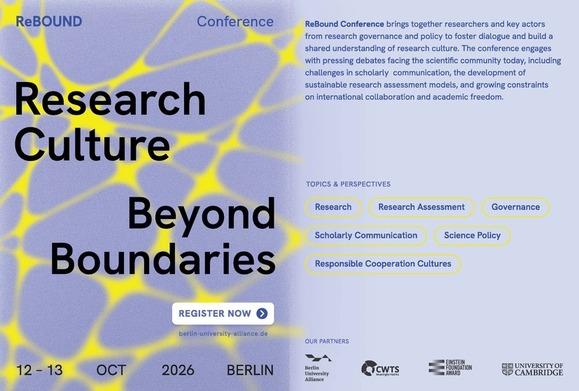
12-13 October 2026, ReBound in Berlin
ReBound conference - Research Culture Beyond Boundaries
Venue: Humboldt-Graduate School of the Humboldt-Universität zu Berlin
The conference aims to foster dialogue and build a shared understanding of research culture. To this end, ReBound brings together researchers and stakeholders from research governance and policy communities, all of whom shape research practice and culture. Together, participants will identify actionable steps to advance research culture in selected areas, drawing on examples of both best and worst practice.
The conference engages with current debates on the challenges facing the scientific community, including pressures on scholarly communication and the need to design and implement sustainable new research assessment models. It also examines increasing constraints on international collaboration and academic freedom, as well as the options available to individual researchers and higher education institutions.
Update
The conference is fully booked! We are overwhelmed by the tremendous interest and enthusiasm.
If you would still like to participate but were unable to secure a place, we invite you to join our waiting list. Should any registered participants cancel, places will be offered to individuals on the waiting list as they become available, until 30 September 2026. Go to waiting list
Three lightning talks bring diverse perspectives to research culture and spark discussion throughout the conference.
Lightning Talk 1: Research
Jens Ambrasat, Robert Merton Center for Science Studies
The research perspective considers empirical and conceptual research on research culture and research practices within regional and national contexts. It addresses how norms, values, incentives, and infrastructures shape scholarly work to help deepen the understanding of how research cultures are formed, sustained, and changed
Lightning Talk 2: Policy
Steven Hill, Digital Science
The policy perspective addresses research culture from the viewpoint of policy design and implementation at international, national, and funder levels. It explores how policies related to research assessment, open science, integrity, and scholarly communication influence research practices and incentives.
Lightning Talk 3: Governance
Julia von Blumenthal, Humboldt-Universität zu Berlin
This perspective examines how research culture is shaped through governance structures and decision-making within institutions, consortia, and scholarly organisations. It focuses on leadership, management, accountability, and coordination mechanisms that influence cultures of research assessment, scholarly communication, etc.
Want to join the conversation? Register now and take part in our interactive fishbowl panel!
Our Workshops
Chose your workshop and help shape the future of research culture
Workshop 1: Research Assessment
Elizabeth Gadd, Loughborough University and Ludo Waltman, Centre for Science and Technology Studies Leiden
This workshop stream focuses on rethinking and improving research assessment. Participants will work on topics relating to evaluation at an institutional level. The workshop will explore what forms of institution-level research assessment could lead to organisations with better and more sustainable, future-fit, research cultures. It aims at contributing towards the translation of principles such as fairness, transparency, and responsible use of indicators into practical assessment approaches that are sensitive to disciplinary and international differences in research performing organisations.
Workshop 2: Scholarly Communication
Priya Silverstein, University of Coimbra and Meta Cramer, Robert Merton Center for Science Studies
This workshop stream explores the contextual factors that shape whether, when, and where researchers across career contexts and different institutional settings publish. In which way and what incentives influence their decisions? How do disciplinary or regional publishing cultures come into play? What are recurring patterns of scholarly publishing that could themselves become objects of study?
Drawing on input from the workshop leads, participants will visually map and discuss the various contextual influences shaping publishing practices and develop ideas for addressing key emerging challenges. While the first day takes a deliberately broad and exploratory approach, the second day focuses on selected issues in greater depth, giving participants the opportunity to identify their most interesting issues and translate potential solutions into actionable recommendations.
Workshop 3: Understanding Research Culture through Stories
Lara Abel, University of Cambridge and Patrick Morris, Menagerie Theatre Company with Vanessa Ackermann and Craig Baxter.
This workshop strand focuses on best and worst research culture practices. Participants will draft their own stories, also referred to as Creative Non-Fiction (CNF) – narrative pieces that read like fiction but are based on actual experiences or data. Based on brainstorming sessions on best and worst research culture practice examples, participants will set out to draft their own CNF. The CNF outputs from the workshop will be published as a booklet.
Workshop 4: Responsible Cooperation Cultures
Romain Faure, Berlin Center for Global Engagement and Patrício Langa, Eduardo Mondlane University
In this conference stream, participants will engage with tools and scenarios that aim to foster collaborations that respect diverse research cultures while promoting shared standards, mutual benefit, and long-term sustainability. The rationale for this is that research cooperation culture is subject to contradictory demands. In some cases, it is expected to be more open and inclusive, while in others, it is necessary to restrict it. These conflicting demands require coordinated efforts to responsibly shape the rapidly evolving landscape of research collaboration.
Present your poster
Are you working in research culture and eager to share your work with an international community of experts? Indicate your interest in the registration form - we’ll follow up with next steps. (Please note that spaces are limited and we may not be able to accommodate all poster registrations).
Our partners