Creating Solutions Together: Participatory Research for a World in Transition
Global crises, climate change, AI, and societal polarization: our world is changing rapidly, and many challenges are more interconnected than they first appear. Researchers at the Berlin University Alliance are therefore exploring interdisciplinary solutions to these major issues of our time. A key element is the active involvement of citizens, ensuring that scientific innovations have a tangible impact on everyday life.

Greenhouse gas emissions from the burning of coal, oil, and gas are the primary drivers of climate change.
Image Credit: Kanenori/Pixabay
The COVID-19 pandemic made one thing unmistakably clear: the world is undergoing profound change. Health crises are spreading ever faster, climate change is now causing extreme temperatures and flooding even in Germany, and the rapid rise of artificial intelligence is making it increasingly difficult to distinguish what is real from what is not. At the same time, societies are becoming more polarized, scientific findings are being questioned, and climate targets are steadily being weakened. Since February 2026, for example, climate-damaging greenhouse gases produced by burning fossil fuels such as coal, oil, and gas are no longer officially classified as hazardous to health in the United States – with negative implications for international climate policy. Additionally, recent developments in Europe, like the revision of the planned 2035 ban on new combustion-engine cars, in favor of manufacturers, are also shaping the public debate.
All of these changes and transformations raise fundamental questions. The fact that many developments are unfolding simultaneously – and influencing one another – makes clear that solutions cannot be considered in isolation. A warming climate, for example, can facilitate the spread of new infectious diseases, as disease carriers such as mosquitoes reproduce more rapidly at higher temperatures. Migration, globalization, and new supply chains also allow diseases to spread more quickly around the world. At the same time, growing distrust in science can make it more difficult to implement solutions such as vaccines or climate protection measures. As a result, ecological, social, and technological challenges must be addressed together and understood as interconnected.
At the Berlin University Alliance (BUA), researchers from different disciplines and institutions are working together to develop sustainable solutions to these major challenges of our time. At the center of this effort are five key areas identified through the Grand Challenges Initiative in response to global transformations: social cohesion, global health, responsible innovation, quantum technologies, and climate change. In laboratories and research facilities, teams collect data, analyze complex problems, and develop new methods and technologies. Yet the decisive step comes at the end of this research chain: translating scientific insights into real-world practice. This can only succeed in a sustainable way if the public is actively involved.
How can an entire population be persuaded to accept a new vaccine? What specific needs do people with disabilities have when it comes to adapting to flooding caused by the climate crisis? How can social cohesion be maintained in an increasingly polarized society? Under what conditions can digital care technologies be successfully introduced in aging populations? And which socially relevant problems might be addressed with quantum technologies?
The perspectives and experiences of citizens provide essential insights into how scientific solutions are accepted and implemented in everyday life. Patterns of use, for example, reveal whether a technology designed in theory actually works in practice. At the same time, participatory research gives a voice to groups that are often underrepresented in social decision-making processes. In this way, it turns people into partners in the scientific process—helping to develop solutions that are both practical and sustainable.
The Grand Challenges
The Grand Challenge themes were developed by expert teams within the alliance and through dialogue between science and society. Two funding lines support their implementation: Exploration Projects, which test new topics, projects, and networks, and Einstein Research Units, which support large-scale interdisciplinary collaborative research. So far, 87 projects have been funded.
From Berlin to Kampala: Rethinking Health on a Global Scale

The COVID-19 pandemic demonstrated that quick solutions may necessitate building new frameworks.
Image Credit: Alexandre C. Fukugava/Pixabay
Global health requires global collaboration. Through its Global Health initiative, the Berlin University Alliance supports interdisciplinary research on key challenges such as vaccines, antibiotic resistance, and aging societies. In close cooperation with partners worldwide, new approaches are being developed that link technological innovations with the needs of people.
The COVID-19 pandemic made one thing unmistakably clear: health knows no borders – neither national, social, nor disciplinary ones. In early 2020, only 22 days passed between the first report of a novel virus in China and the first confirmed infection in Germany. As the disease spread rapidly across countries and claimed hundreds of lives, global stock markets collapsed just two months after the outbreak began.
The situation demanded swift action and made something possible that had previously seemed unthinkable: existing structures were broken open. Cross-disciplinary and cross-industry alliances to develop a vaccine formed almost overnight, bureaucratic hurdles were temporarily reduced, and approval procedures were accelerated. The pandemic showed that health is not a national, one-dimensional issue – it is a global and interdisciplinary challenge.
Even before the pandemic, the Berlin University Alliance (BUA) had identified Global Health as one of the major challenges of our time. As part of its Grand Challenges Initiative, BUA is funding five interdisciplinary Exploration Projects and one strategic project with more than €7.2 million, all aimed at addressing pressing global health issues. The projects focus on topics such as aging societies in urban regions, gender-specific health needs among migrant populations, and the growing problem of antibiotic resistance.
A particular focus of the Global Health research initiative lies in collaboration with partner institutions around the world – especially in the Global South. Such partnerships are essential, emphasizes health researcher Hanna-Tina Fischer. “International collaboration is not an option but both substantively and institutionally essential,” she says. “Many countries have long-standing experience in dealing with epidemics or community-based health approaches.” At the same time, countries in the Global North are increasingly facing their own vulnerabilities – for example in supply chains or in questions of societal acceptance. “Learning therefore happens in both directions,” the global health expert explains.
Since January 2026, Fischer has been conducting research in the Einstein Research Unit “Technologies in Global Health – From innovation to users (and back)”, funded by BUA and the Einstein Foundation Berlin. Together with seven academic partner institutions in Ghana, Tanzania, and Uganda, the consortium investigates how new technologies in the fields of vaccines, antimicrobial resistance, and mental health can be developed, tested, adapted, and implemented. A particular focus lies on the users of these health technologies, aiming to understand which factors enable their successful use – and which may hinder it.
Yet despite its importance, this collaboration faces structural challenges, Fischer notes. “Research questions, funding frameworks, and publication structures are still largely anchored in the Global North.” In Germany, she adds, there is a specific tension: many research funds – including those for Global Health – are expected to be spent primarily within the country, as they come from public tax revenue. While understandable, this approach reaches its limits when addressing global health issues. “If research cannot be adequately funded where risks actually emerge, not only genuine partnership becomes more difficult, it also weakens both the quality and the significance of the results”, Fischer says. “What is often overlooked is that investing in international research also strengthens our own preparedness—for example through better pandemic readiness, more resilient supply chains, or earlier insights into emerging risks.” International research, she concludes, is therefore not only a matter of global solidarity but also of strategic foresight.
Beyond the Global Health initiative, health remains a central focus in the research of the Berlin University Alliance (BUA). For example, the project “Inclusive Food System Transitions”, part of the Grand Challenge Social Cohesion, examined how social cohesion is linked to inequalities and vulnerabilities in food systems—and the health issues that arise from them. The project integrated perspectives from social and political sciences, nutrition and innovation systems research, food technology, as well as medical and nutritional sciences. Building on these insights, one of the project’s researchers, Tilman Brück from Humboldt Universität zu Berlin (HU Berlin), together with colleagues from Technische Universität Berlin (TU Berlin) and the Leibniz Institute for Vegetable and Ornamental Crops (IGZ), launched a new study. Through an anonymous online survey, they aim to explore how different approaches to climate communication are perceived by the public.
With its new One Health initiative, the BUA is taking an even broader approach—looking at how humans, animals, and the environment interact. This includes situations where diseases are transmitted from animals to humans, environmental changes affect living conditions and health, and human actions, in turn, impact ecosystems. One Health views health as the result of interlinked biological, ecological, and social factors, and requires close collaboration with disciplines such as environmental and veterinary sciences. Public participation remains central: citizens provide crucial knowledge about daily practices, mobility, animal husbandry, working conditions, and health behaviors. These factors strongly influence how pathogens spread and how protective measures work—and are therefore essential for future research.
The Grand Challenges Conference

Grand Challenges Konferenz
Image Credit: Grand Challenges Konferenz/ BUA
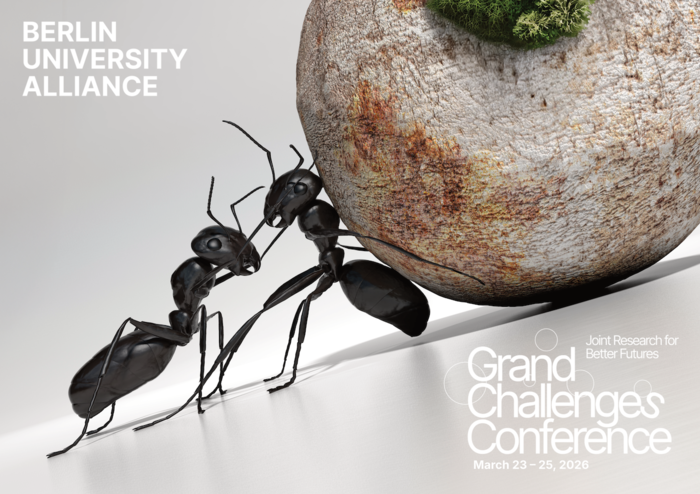
Under the title “Joint Research for Better Futures”, around 300 participants will gather at the Berliner Futurium from March 23 to 25, 2026 for the Grand Challenges Conference, to explore pathways toward a sustainable future. At the heart of the conference are five major challenges of our time—the Grand Challenges: Global Health, Social Cohesion, Climate and Water under Change, Quantum Technologies, and Responsible Innovation in Times of Transformation.
In more than 20 sessions, researchers will offer exciting insights into their work and share the results of their studies. Prominent keynote speakers will provide fresh perspectives on how to tackle the complex problems of our era. Transformational researcher Maja Göpel will discuss positive social tipping points, social scientist Naika Foroutan will explore the future of social cohesion, and physicist Jerry Chow will highlight advances in quantum technologies.
Beyond inspiring keynotes, engaging discussions, and a showcase of excellent research across disciplines, participants can look forward to ample opportunities for networking, collaboration, and exchange.